| Audie Murphy Petition Draws Major Endorsements Murphy: a pioneer in PTSD awareness September 9, 2013 by David Phillips |
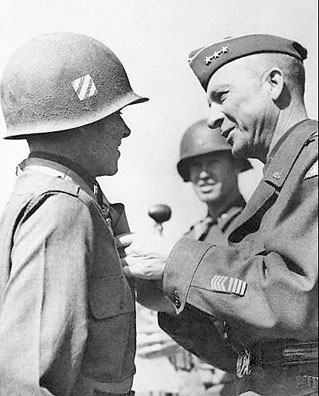
 Audie Murphy, moments after being awarded the Medal of Honor and
Legion of Merit, Salzburg, Austria, 1945. Courtesy U.S. Army.
Audie Murphy, moments after being awarded the Medal of Honor and
Legion of Merit, Salzburg, Austria, 1945. Courtesy U.S. Army. |
| Endorsements on the Audie Murphy Presidential Medal of Freedom Petition read like a VIP address book. Distinguished Americans such as Melvin Laird, Bob Dole, General Tommy Franks, Charlie Duke, Toby Keith, Dan Rather, Barbara Eden and countless others too numerous to mention. In addition to those named above, three-fourths of the 79 living Medal of Honor recipients have offered forth their endorsements.Finally, representing service over seven decades to America, nearly 100 generals and admirals have endorsed the petition. These flag officers represent every branch of service and level of command of the armed forces to include two former chairman of the joint chiefs of staff. Each has personally hand signed the petition.A final tribute for Major Audie MurphyThese prominent citizens have united with the common goal of honoring this legendary American soldier with one last final tribute. Thousands of ordinary citizens from across the country and around the world have joined those notable distinguished Americans in signing the online version of the petition hosted on the website ipetitions as well as on the Audie Murphy Memorial website.America’s highest civilian honorThe petition, directed to the President of the United States, requests that the late Major Audie Murphy, Medal of Honor recipient and the “most decorated” soldier of World War II, be posthumously awarded the Presidential Medal of Freedom, our nation’s highest civilian honor. The Presidential Medal of Freedom is awarded to those who have made significant contributions to the security and/or national interest of the nation, world peace or for lifetime achievement in other cultural or significant public or private endeavors.Following World War II Audie Murphy went on to a successful career as a film star appearing in 44 feature films, most of them westerns. He appeared on television making guest appearances, wrote poetry, country music and raised champion quarter horses and thoroughbreds.Audie Murphy – a pioneer in PTSD awareness Although the name of Audie Murphy would certainly merit consideration for this most prestigious honor for his many contributions to American culture and his Hollywood career, the petition and recommendation, is based on a much more complex issue, one that Murphy assuredly had a significant role in raising awareness of…Post-Traumatic-Stress-Disorder (PTSD). In his endorsement of Audie Murphy, former Sen. Bob Dole, referred in part to Murphy as a “true pioneer in PTSD awareness.” Sen. Dole is a disabled World War II combat veteran and a recipient of the Presidential Medal of Freedom as well. While Audie Murphy’s name is known to many, it is almost unknown to the average American that Murphy suffered from PTSD. Beginning after World War II and continuing throughout his life Murphy became one of the first veterans to speak of PTSD. Over the last years of his life Audie Murphy often reflected on war and its toll on the human mind. Murphy displayed remarkable courage during an era when it was deemed “unmanly” to show perceived weakness and speak about what was then only known as “shell-shock.” In the years immediately following World War II, “shell-shock” was often associated with “cowardliness” or “physical weakness” but Murphy, while never glamorizing his own heroism, managed to parlay his international stardom and name recognition to his advantage and helped turn the tables on the stigma often associated with PTSD. He spoke candidly with the media about the emotional effects of the war and the nightmares associated with it. In doing so, Audie Murphy served as an advocate for returning veterans of both the Korean and Vietnam wars and helped bring the issue of PTSD and the need for early diagnosis and treatment of this illness into the mainstream of American society. In a 1955 interview at the time of the release of his now indelible appearance in the autobiographical film “To Hell and Back,” Murphy remarked that “War is like a giant pack rat. It takes something from you and leaves something behind in its stead. It burned me out in some ways so that now I feel like an old man but still sometimes act like a dumb kid. It made me grow up too fast. You live so much on nervous excitement that when it is over, you fall apart. That’s what war took from me, the excitement of living.” In 1961 he offered forth the following commentary: “After the war, they took the dogs and rehabilitated them for civilian life. But they turned soldiers into civilians and let ‘em sink or swim.” Audie Murphy is credited by the Amy with having killed more than 240 of the enemy while wounding more than 500 and capturing about 100. Some years after the war when asked by a reporter how the Army could arrive at such casualty figures Murphy retorted, “I don’t know how they know. Maybe the War Department kept count somehow. Maybe the officers sent in totals. I didn’t keep count. I don’t know how many. I don’t want to know.” In a subsequent interview when asked the question “How does it feel to have killed 240 men?” Murphy remarked, “To begin with, I didn’t kill that many; how the hell does anyone think it felt. It didn’t feel either way; good or bad. Feeling wasn’t a luxury in the infantry.” Perhaps one of his more eloquent and reflective statements came in a 1967 interview by Thomas Morgan of the Chicago Times. In the interview Audie Murphy stated, “To become an executioner, somebody cold and analytical, to be trained to kill, and then to return to civilian life and be alone in the crowd—-it takes an awful long time to get over it. Fear and depression come over you. It’s been twenty-odd years already, and the doctors say the effect of all this on my generation won’t reach its peak until 1970. So, I guess I got three years to go.” Sadly though and almost prophetically, Audie Murphy had only four years remaining in his own life, four years in which to ride the emotional roller-coaster of mental anguish agitated by his own inner turmoil and the demons that haunted his sleepless nights. Murphy over the course of almost 25 years, beginning with the release of his memoirs in 1949, attempted to show the brutality of war and the mental toll war exerts on a soldier. In almost every memorable interview he would bring up the subject of “shell-shock” and the nightmares in order to inform the public of the affects of war on the human spirit. Near the end of his short life, Audie Murphy was asked in an interview “How does a soldier get over a war” to which the ever sad Murphy lowered his head and with a barely audible voice reflected, “I don’t think they ever do.” His first wife, the actress Wanda Hendrix, offered this poignant but sad commentary on Murphy following his death: “Audie had a beautiful smile, unfortunately he didn’t smile much.” Audie Murphy – his legacy continues Honors are rendered and tributes bestowed by great societies so that we may remember the person; and the accomplishments of that person’s life and in doing so perpetuate their memory for future generations. Audie Murphy has certainly been accorded many tributes over the years since his untimely passing and his legacy continues to grow with the passage of time. The name of Audie Murphy has been cited in the Congressional Record on numerous occasions. Additionally, he has had schools, monuments, markers, highways, bridges, a Veterans Administration hospital and numerous facilities on military installations named in his honor. The Army today has the “Sergeant Audie Murphy Club” to honor its most distinguished non-commissioned officers. Audie Murphy has further received a “Star” on the Hollywood Walk of Fame, and was inducted into the National Cowboy Hall of Fame. In addition, in 1995 he was honored with postage stamps by the governments of Guyana, Nevis and Sierra Leone. In 2000 he was finally honored with a commemorative United States postage stamp as a testament to his status as an iconic figure in American history. Most recently, the author lead a national campaign to have Audie Murphy awarded the Texas Legislative Medal of Honor, the supreme military honor in the state of Texas. That campaign resulted in Gov. Rick Perry posthumously bestowing Major Murphy the Texas Legislative Medal of Honor this past month. Perhaps his single greatest honor is having been laid to rest after his untimely death in a plane crash at age 46 at Arlington National Cemetery. He lies amongst those that represent the finest in America, and Audie Murphy was certainly one of the finest of America’s soldiers and one of the greatest of our nation’s heroes. The Presidential Medal of Freedom would be one final fitting honor for Audie Murphy, so that he may once again be remembered by the citizens of Texas, and indeed all Americans. The petition is due to close in the coming days and the formal recommendation submitted to the White House for action. David Phillips – Mr. Phillips is the Executive Administrator of the Audie Murphy Presidential Medal of Freedom Petition Campaign. In addition, he initially recommended Audie Murphy for this honor and spearheaded the campaign for its passage. The petition has the endorsement of more than 100 general officers, 50 of the 79 living medal of honor recipients, moonwalkers, members of congress, & celebrities. The nomination will be based upon Audie Murphy’s advocacy for better treatment of veterans suffering from PTSD |
 On the anniversary of Audie Murphy’s death
at his memorial on Brush Mountain in Virginia
with two WWII veterans of 3ID –
MG Lloyd B. Ramsey and Robert Dutil with Tim &
Monika Stoy.
Awesome!
On the anniversary of Audie Murphy’s death
at his memorial on Brush Mountain in Virginia
with two WWII veterans of 3ID –
MG Lloyd B. Ramsey and Robert Dutil with Tim &
Monika Stoy.
Awesome! |
|
“I never liked being called the ‘most decorated’ soldier. There were so many guys who should have gotten medals and never did – guys who were killed.” |
|
“Men who have offered their lives for their country know that patriotism is not fear of something; it is the love of something.” Adlai Stevenson-1952 speech to American Legion |

Colonel Henry Bodson, SGT Audie Murphy Club Speaker
 Col Henry Bodson
 Words of Wisdom
 Col Bodson with SGT Audie Murphy Club Inductees
 Ryan Joseph, Col Henry Bodson,
LTC Tim Stoy, CPT Monika Stoy
Ryan Joseph, Col Henry Bodson,
LTC Tim Stoy, CPT Monika Stoy
Colonel Henry Bodson, Society of the 3ID member of Outpost 7 and WWII veteran of the 39th Field Artillery, recently served as the guest speaker at a 9 April induction ceremony for two noncommissioned officers from the Military District of Washington into the Sergeant Audie Murphy Club (SAMC). The event was held in Conmy Hall of Fort Myer, the home of the United States Army’s 3rd Infantry Regiment, the Old Guard. The Sergeant Audie Murphy Club is comprised of noncommissioned officers who have exhibited exceptional leadership in their positions as leaders in their units.
Colonel Bodson was invited to speak because he knew Audie Murphy, having first met him during training in Podzuoli, Italy in preparation for Operation Dragoon. Then Captain Bodson, a battery commander in the 39th Field Artillery, was tasked to train a group of 30 noncommissioned officers from the 15th Infantry to call for and adjust indirect fire. The first soldier called to exhibit his skills after the training was Staff Sergeant Audie Murphy, who successfully called for and adjusted fire on a target floating in the Bay of Naples. Actually, he blew it to smithereens!
Bodson would later encounter Murphy after he had been commissioned and been recommended for the Medal of Honor for his actions at Holtzwihr, France on 26 January 1945. It is highly probable the training Bodson provided in Podzuoli came in to effect as Murphy called for the murderous artillery fires during his action. When Murphy returned to the 15th Infantry Regiment and was put in Regimental Headquarters, then CPT Bodson was the 39th FA liaison officer in the headquarters and he had several months of shared service with Murphy in the operations shop of the Regiment before the war ended in May 1945.
COL Bodson shared these and several other stories of Audie Murphy which illustrated the character of the man the noncommissioned officers in the Sergeant Audie Murphy Club strive to emulate. His 35 minute speech was very well-received by the 500 soldiers and noncommissioned officers who were present from the 3rd Infantry Regiment and SAMC members from the Military District of Washington (MDW)which extends as far as Fort Dix, New Jersey and includes Fort Meade, Maryland. The presiding officers for the ceremony were Major General Linnington, Commanding General of the MDW; Command Sergeant Major Turnbull, CSM of the MDW; and Master Sergeant William Haddon, President of the MDW Chapter of the Sergeant Audie Murphy Club. The ceremony was supported by soldiers of the 3rd Infantry Regiment, “The Old Guard”, who provided the color guard and a program on the history of the NCO Corps from the Revolutionary War to today.
The MDW chapter of SAMC has supported OP Europe’s Operation Dragoon and Battle of the Colmar Pocket for several years in Arlington, Virginia. The chapter was very pleased and honored that Colonel Bodson spoke at this ceremony. One of the NCOs inducted was SFC Ryan Joseph, who is a veteran of four Iraq deployments with the 7th Infantry Regiment of the 3rd ID and is now the Platoon Sergeant of the United States Army Drill Team. It was great to see that 3rd Infantry Division combat service badge on his uniform!

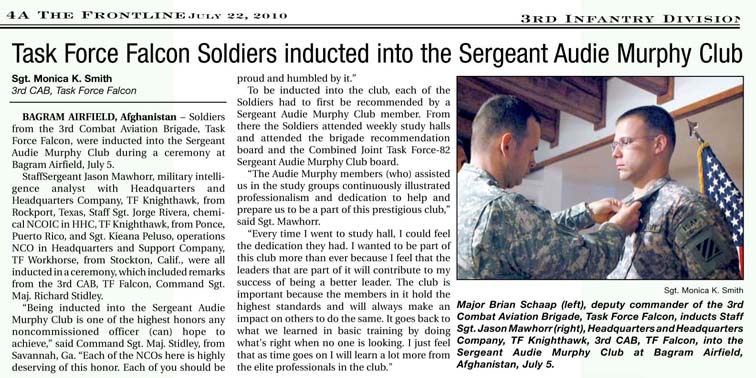 The Legacy of Audie Murphy
A story of the Audie Murphy Club
The Legacy of Audie Murphy
A story of the Audie Murphy Club
|
|
|
 Stackable Mug Set (4 mugs)
 |
 Audie Murphy Large Mug
 |
 Audie Murphy Rectangle Magnet
 |
 Audie Murphy Stein
 |
|
People, as you may know Audie’s highest rank was that of Major which is reflected on his headstone. I have never seen any photographic prints but I did locate in my inventory the following gem. It is a color painting of Audie with Major’s rank. This was for the cover of a National Memorial Air Tribute [Audie Murphy Memorial Air Show] Sunday, May 28-29, 1972 in New Castle, PA. Not too bad for an artist’s rendition. Stan Smith |


|
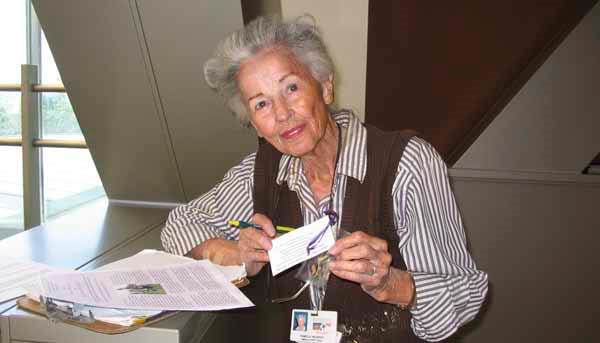
Pam Murphy Dies, Widow of Audie Murphy,
Was veterans’ friend and advocate
Read Dennis McCarthy’s story in the Los Angeles Daily News at http://www.dailynews.com/news/ci_14885262 By Dennis McCarthy, Columnist Updated: 04/14/2010 Copyright ©2010 Los Angeles Newspaper Group |
|
|
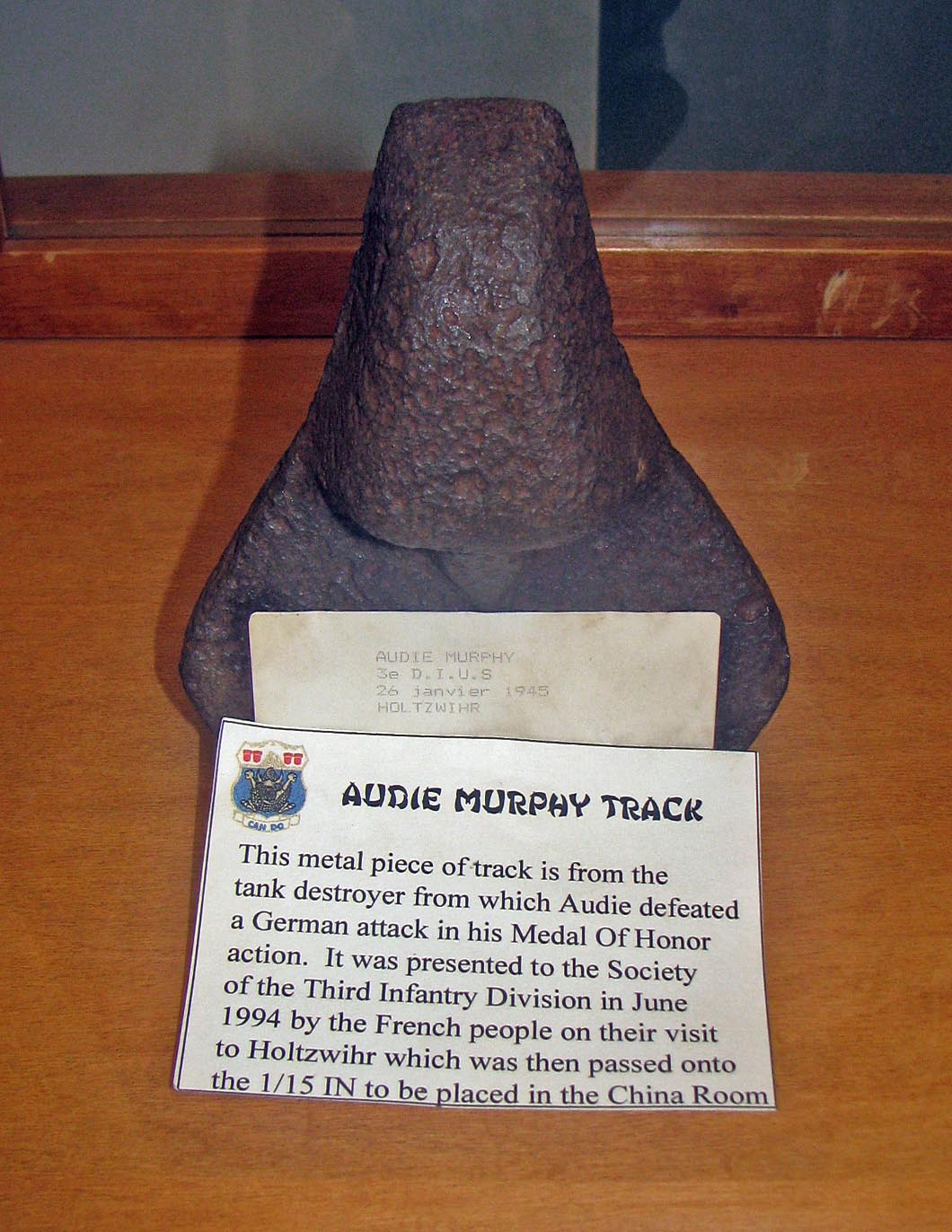 In the China Room at Fort Benning
|
I Have Fought a Good Fight I Have Finished My Course I Have Kept the Faith |

|
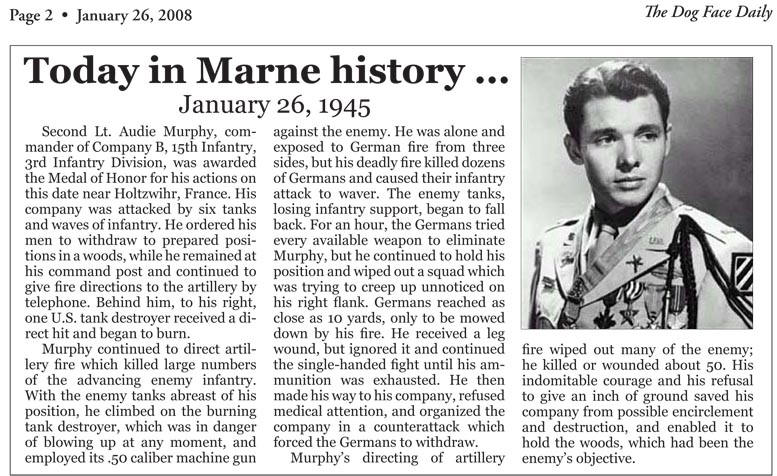
Murphy, Audie L. Rank and organization: Second Lieutenant, U.S. Army, Company B 1 5th Infantry, 3d Infantry Division. Place and date: Near Holtzwihr France, 26 January 1945. Entered service at: Dallas, Tex. Birth: Hunt County, near Kingston, Tex. G.O. No.. 65, 9 August 1945. Citation 2d Lt. Murphy commanded Company B, which was attacked by 6 tanks and waves of infantry. 2d Lt. Murphy ordered his men to withdraw to prepared positions in a woods, while he remained forward at his command post and continued to give fire directions to the artillery by telephone. Behind him, to his right, 1 of our tank destroyers received a direct hit and began to burn. Its crew withdrew to the woods. 2d Lt. Murphy continued to direct artillery fire which killed large numbers of the advancing enemy infantry. With the enemy tanks abreast of his position, 2d Lt. Murphy climbed on the burning tank destroyer, which was in danger of blowing up at any moment, and employed its .50 caliber machinegun against the enemy. He was alone and exposed to German fire from 3 sides, but his deadly fire killed dozens of Germans and caused their infantry attack to waver. The enemy tanks, losing infantry support, began to fall back. For an hour the Germans tried every available weapon to eliminate 2d Lt. Murphy, but he continued to hold his position and wiped out a squad which was trying to creep up unnoticed on his right flank. Germans reached as close as 10 yards, only to be mowed down by his fire. He received a leg wound, but ignored it and continued the single-handed fight until his ammunition was exhausted. He then made his way to his company, refused medical attention, and organized the company in a counterattack which forced the Germans to withdraw. His directing of artillery fire wiped out many of the enemy; he killed or wounded about 50. 2d Lt. Murphy’s indomitable courage and his refusal to give an inch of ground saved his company from possible encirclement and destruction, and enabled it to hold the woods which had been the enemy’s objective. |
|
Major General John “Iron Mike O’Daniel
presents
1st Lt. Audie L. Murphy
the Distinguished Service Cross
and Silver Star Medals
On March 5, 1945, 1st Lieutenant Audie Murphy was called to Nancy, France by order of the 3rd Infantry Division Commander, Major General John “Iron-Mike” O’ Daniel. On this day, General O’ Daniel presented to 1st Lieutenant Murphy the Distinguished Service Cross and Silver Star. After ‘Iron Mike” pinned the medals on Audie’s uniform, he pulled out of his pocket a Medal of Honor. Without giving it to Audie, O’ Daniel showed the medal to him and stated that General Alexander Patch, the 7th Army Commander, would soon pin it on Audie during a different ceremony. The Medal of Honor was given to Murphy June 2, 1945 at the airport of Salzburg by General Patch, CG 7. Army. Some members of US-congress where present at this ceremony. See photos below. |


| Medals and Awards of Honor Courtesy of Stan Smith | |
 |
 |
|
The President of the United States of America, authorized by Act of Congress, March 3, 1863, has awarded in the name of The Congress the MEDAL OF HONOR to LIEUTENANT AUDIE L. MURPHY UNITED STATES ARMY Citation: For conspicuous gallantry and intrepidity in action at the risk of his life above and beyond the call of duty, Second Lieutenant Audie L. Murphy, 01692509, 15th Infantry, Army of the United States, on 26 January 1945, near Holtzwihr, France, commanded Company B, which was attacked by six tanks and waves of infantry. Lieutenant Murphy ordered his men to withdraw to prepared positions in a woods, while he remained forward at his command post and continued to give fire directions to the artillery by telephone. Behind him, to his right, one of our tank destroyers received a direct hit and began to burn. Its crew withdrew to the woods. Lieutenant Murphy continued to direct artillery fire which killed large numbers of the advancing enemy infantry. With the enemy tanks abreast of his position, Lieutenant Murphy climbed on the burning tank destroyer, which was in danger of blowing up at any moment, and employed its .50-caliber machine gun against the enemy. He was alone and exposed to German fire from three sides, but his deadly fire killed dozens of Germans and caused their infantry attack to waver. The enemy tanks, losing infantry support, began to fall back. For an hour the Germans tried every available weapon to eliminate Lieutenant Murphy, but he continued to hold his position and wiped out a squad which was trying to creep up unnoticed on his right flank. Germans reached as close as 10 yards only to be mowed down by his fire. He received a leg wound but ignored it and continued the single-handed fight until his ammunition was exhausted. He then made his way to his company, refused medical attention, and organized the company in a counterattack which forced the Germans to withdraw. His directing of artillery fire wiped out many of the enemy; he killed or wounded about 50. Lieutenant Murphy’s indomitable courage and his refusal to give an inch of ground saved his company from possible encirclement and destruction, and enabled it to hold the woods which had been the enemy’s objective. |
|
|
“Loyalty to your comrades, when you come right down to it, has more to do with bravery in battle than even patriotism does. You may want to be brave, but your spirit can desert you when things really get rough. Only you find you can’t let your comrades down and in the pinch they can’t let you down either.” |
|
 |
 159th French Alpine Infantry Regiment.
This crest is the insignia of the 159th French Alpine Infantry Regiment. It is a lozenge shaped shield, consisting of an edelweiss flower, mountain ridge and the numeral “159”. It measures 30mm at its widest point and is 52mm high. The 159th R.I.A. (Regiment – Infantry – Alpine) existed from 1944-1951. In 1951, it became the B.I.A. (Battalion – Infantry – Alpine), along with a new design. Then in 1964, was re-designated the 159th R.I.A., and changed its unit insignia to the lozenge shaped shield. The 159th no longer exists and consequently the badge is a collector’s piece. Audie was presented with the device by the Mayor of Ramatuelle, France on July 13, 1948. Audie was in France to be decorated by General de Lattre de Tassigny with the French Legion of Honor (Chevalier) and the French Croix de Guerre with Palm, which took place on July 19, 1948. This is an unofficial, honorary award and there are numerous photos showing Audie wearing it such as the attached. |
|
“I have to admit I love the damned Army. It was father, mother, brother to me for years. It made me somebody, gave me self-respect.” |
|
%20decree%207-19-48b.jpg) |
 |
|
“I was proud of being a tough soldier.” |
|
 |
 |
|
“I never moved into combat without having the feeling of a cold hand reaching into my guts and twisting them both into knots.” |
|
 |
|
|
General Orders No. 65 WAR DEPARTMENT Washington 25, D. C., 9 August 1945 Section 1 MEDAL OF HONOR – Award …………………………………….. * * * * * * I.. MEDAL OF HONOR. – By direction of the President, under the provisions of the act of Congress approved 9 July 1918 (WD Bul. 43, 1918), a Medal of Honor for conspicuous gallantry and intrepidity at the risk of life above and beyond the call of duty was awarded by the War Department in the name of Congress to the following-named officer: Second Lieutenant Audie L. Murphy, 01692509, 15th Infantry, Army of the United States, on 26 January 1945, near Holtzwihr, France, commanded Company B, which was attacked by six tanks and waves of infantry. Lieutenant Murphy ordered his men to withdraw to a prepared position in a woods while he remained forward at his command post and continued to give fire directions to the artillery by telephone. Behind him to his right one of our tank destroyers received a direct hit and began to burn. Its crew withdrew to the woods. Lieutenant Murphy continued to direct artillery fire which killed large numbers of the advancing enemy infantry. With the enemy tanks abreast of his position, Lieutenant Murphy climbed on the burning tank destroyer which was in danger of blowing up any instant and employed its .50 caliber machine gun against the enemy. He was alone and exposed to German fire from three sides, but his deadly fire killed dozens of Germans and caused their infantry attack to waver. The enemy tanks, losing infantry support, began to fall back. For an hour the Germans tried every available weapon to eliminate Lieutenant Murphy, but he continued to hold his position and wiped out a squad which was trying to creep up unnoticed on his right flank. Germans reached as close as 10 yards only to be mowed down by his fire. Be received a leg wound but ignored it and continued the single-handed fight until his ammunition was exhausted. He then made his way to his company, refused medical attention, and organized the company in a counterattack which forced the Germans to withdraw. His directing of artillery fire wiped out many of the enemy; he personally killed or wounded about 50. Lieutenant Murphy’s indomitable courage and his refusal to give an inch of ground saved his company from possible encirclement and destruction and enabled it to hold the woods which had been the enemy’s objective. * * * * * * BY ORDER OF THE SECRETARY OF WAR: OFFICIAL: EDWARD F. WITSELL G. C. MARSHALL Major General Chief of Staff Acting The Adjutant General FILE: Beard/src/SAD-SA |
|
 |
|
 |
 |
| Lieutenant Audie Murphy of B Company, 15th Regiment, Third Division. Murphy received the Medal of Honor and the Legion of Merit on June 2, 1945 in front of his entire division in Salzburg, Austria. Murphy became known as the most decorated soldier in the U.S. Army and went on to be a major American film star until his death in 1971. Courtesy of Stan Smith | |
|
Dusty Old Helmet Dusty old helmet, rusty old gun, They sit in the corner and wait – Two souvenirs of the Second World War That have withstood the time, and the hate.
Many times I’ve wanted to ask them – And now that we’re here all alone, Relics all three of a long ago war – Where has freedom gone?
Mute witness to a time of much trouble, Where kill or be killed was the law – Were these implements used with high honor? What was the glory they saw?
Freedom flies in your heart like an eagle. Let it soar with the winds high above Among the spirits of soldiers now sleeping, Guard it with care and with love.
I salute my old friends in the corner. I agree with all they have said – And if the moment of truth comes tomorrow, I’ll be free, or By God, I’ll be dead! Audie Murphy |
|
 On June 2, 1945 The entire Third Division assembled
to witness the Medal of Honor ceremony for 15th Regiment Lieutenant Audie
Murphy in Salzburg, Austria. Murphy rebuffed a grave threat to his company
atop a crippled tank destroyer in the Colmar Pocket near Holtzwihr.
Seventh Army Commander Alexander Patch presented the honors.
Photo courtesy of Denis Toomey
www.dogfacesoldiers.org
On June 2, 1945 The entire Third Division assembled
to witness the Medal of Honor ceremony for 15th Regiment Lieutenant Audie
Murphy in Salzburg, Austria. Murphy rebuffed a grave threat to his company
atop a crippled tank destroyer in the Colmar Pocket near Holtzwihr.
Seventh Army Commander Alexander Patch presented the honors.
Photo courtesy of Denis Toomey
www.dogfacesoldiers.org |
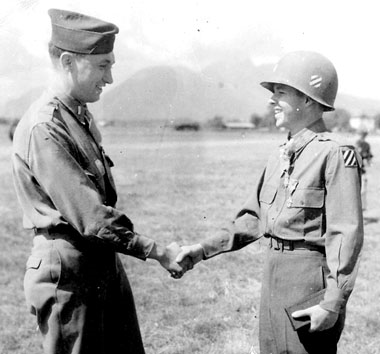 Liaison Officer for the 15th Regiment Lt. John J.
Tominac congratulates Lieutenant Audie Murphy after the June 2, 1945 Medal
of Honor ceremony in Salzburg. Murphy became a movie star after the war
making 44 films and wrote an autobiography “To Hell and Back.”
Photo courtesy of Denis Toomey
www.dogfacesoldiers.org
Liaison Officer for the 15th Regiment Lt. John J.
Tominac congratulates Lieutenant Audie Murphy after the June 2, 1945 Medal
of Honor ceremony in Salzburg. Murphy became a movie star after the war
making 44 films and wrote an autobiography “To Hell and Back.”
Photo courtesy of Denis Toomey
www.dogfacesoldiers.org |
|
Only Photo of Hero Getting Medal Published First Time BY JAMES BACON
HOLLYWOOD, June 2, 1955 (AP) – Ten years ago Thursday on an Austrian airstrip, a general pinned the Medal of Honor on a Texas boy so young that he couldn’t even grow a mustache. The ceremony climaxed one of the most amazing fighting careers in American military history and made 2nd Lt. Audie Murphy the most decorated hero of World War II. Yet there was no official photograph made that day – but a Red Cross doughnut girl snapped a picture with a box camera. It was in her scrapbook until Murphy, now a movie star, went on location near Yakima, Wash., for the filming of his own exploits in “To Hell and Back.” She had a reunion there with Murphy and gave him the snapshot. Thanks to Stan Smith for this photo and story. |
|
March 9, 2001: The 3rd Infantry Division Mechanized dedicated a facility, The Audie Murphy Inn, at Eagle Base, Tuzla, in Bosnia-Herzegovina to the memory and accomplishments of Audie Murphy. This is a two story, 4,700 square foot, 27 room, guest house for visitors to stay while they visit the hard working soldiers of the Multinational Division (North). |

|
|
Fort Stewart Names Soldier Center for War Hero 2nd Lt. Audie Murphy July 11, 2007- Soldiers at Fort Stewart are honoring one of their own. 2nd Lt. Audie Murphy was the Army’s most decorated war hero and a member of the Third Infantry Division. Now, the Third ID is making sure his names lives on at a center designed to help soldiers. Third Infantry Division soldiers proudly stood in front the 2nd Lt. Audie Murphy Soldier Support Center. Murphy, a Medal of Honor recipient, single handedly, atop a burning tank, protected his men against the enemy during World War Two. He killed dozens of Germans, forcing them to withdraw. His name now graces Fort Stewart’s Soldier Support Center, a place where soldiers, families and civilians arriving, leaving or transferring within the army can take care of all their paperwork. “He’d love it,” said Murphy’s best friend Scott Turner. “He would love it.” Audie Murphy went on to more great things, like acting and a successful song writing career with Turner. The two would compose more than 80 songs, including the gold record country hit, “Shutters and Boards;” however, Turner said, this would mean more to him. “This to Audie,” he said, “a building named for Audie with the Third Army, I mean, that was his life.” The 2nd Lt. Audie Murphy Soldier Support Center is just one of several buildings dedicated for Medal of Honor recipients. The Third ID hopes when soldiers and military families walk these halls, they’ll be inspired by the men these buildings are named after. “We want them to know, one what this division means,” said Garrison Commander Colonel Todd Buchs. “And that it had heroes like Audie Murphy and they, too, are heroes.” Murphy never lived to see this honor. He died in a plane crash in 1971 at the age of 46. He was buried with full military honors at Arlington National Cemetery. Scott Turner is planning a concert series with the songs the two men wrote. He said he’ll donate the proceeds to the Fisher House, a home away from home that allows military families to be near their injured loved ones. To learn more about 2nd Lt. Audie Murphy, visit www.audiemurphy.com or www.warfoto.com/AudieMurphy Reported by: Liz Flynn |
|
Here’s a photo of Audie Murphy’s Carbine (After re-furbishing after the war)
|
|
|
| Würzburg, Germany, June 17, 1960: If Sp4 Kenneth Coward, left, seemed a little nervous as he talked about his M1 rifle with a visitor to the base, it was understandable. The civilian was America’s most-decorated soldier of World War II, Audie Murphy, who was making a documentary film about missiles used by the Army. Murphy was in Germany for the first time since the war, when his exploits earned him the Medal of Honor, Distinguished Service Cross, two Silver Stars, three Purple Hearts and many other awards. Courtesy of Stan Smith |


|
Audie Murphy’s second monument grows stone by stone – Roanoke Times, Roanoke,VA |
| Monday was Memorial Day, as you know, but you may have missed the significance of last Sunday.World War II hero Audie Murphy died in a plane crash May 28, 1971, at the top of Brush Mountain.The out-of-the-way location of his death makes visiting the site a bit of an undertaking. It’s a goodly drive from Blacksburg out Mount Tabor Road to a bumpy forest service road that takes you to a littered parking area. From there it’s a 0.7-mile walk to the monument. But this location has actually led to a moving tribute from an unlikely source. The site is just off the Appalachian Trail, where it may get more visits from hikers than from anyone else. The monument is topped by little piles of stones. Many more stones are piled on the ground next to it.Two through-hikers I saw there recently — Rush Hour and Firefly were their trail names — understood what to do, and each added their own stone. It’s simple, but certainly one of the most sincere ways of honoring a veteran that I’ve ever seen. The many small tokens of appreciation added up to a second monument of sorts.The original monument itself is quite nice and explains that Murphy was the most-decorated American soldier of all the men who fought in World War II. But what’s missing is a photo of Murphy. The two hikers I saw seemed genuinely interested and spent longer looking at the monument than I would have expected. But I imagine that seeing his photo would have helped them realize that the man behind the many medals was a fellow about their age when he earned those decorations.Bottom line: Through a strange fluke of geography, Audie Murphy’s monument is visited by young folks who might not normally visit a military monument. I can’t help but think that Murphy would be mighty pleased.Suggested viewing: “To Hell and Back,” starring Audie Murphy as Audie Murphy in the true story of his World War II heroics. Directions: The monument is right on the border between Craig and Roanoke counties, but is easily found when driving from Blacksburg. Take North Main Street to Mount Tabor Road, which will twist and turn and offer at least one unexpected stop sign. After crossing into Roanoke County, look for a sign pointing to a forest service road. Take this to the top of the mountain and turn right. Follow this road to a parking area. Another sign here guides you to the trail that soon meets up with the Appalachian Trail. When the path splits, take the left fork up to the monument. |
|
Audie’s grave is located in Section 46, marker 366-11
Audie Murphy’s gravesite at the Arlington National Cemetery in Washington. DC is the second most visited gravesite behind the J. F. Kennedy section. Audie’s headstone is the same as the ordinary GI, as was his request. Most of the elite have gold inlays on the headstone.The pebbles and coins on the top of the headstone, denote people visiting and leaving a stone or coin is an old Jewish tradition to show that the gravesite has been visited. |


|
Washington Post June 1971 Audie Murphy Buried With Military Rites at Arlington
By Ken Ringle Washington Post Staff Writer Audie Murphy was buried yesterday beneath a white oak tree in Arlington National Cemetery in a ceremony that briefly brought together Murphy’s disparate worlds as most decorated soldier and undistinguished cowboy actor. A horse-drawn caisson, trailing the muffled drums and soft hymns of the Army band, bore the walnut casket of the baby-faced World War II hero through a crowd of 400. The mourners ranged from Gen. William Westmoreland – in full uniform – to Marty Benson – a goateed race horse handler and pallbearer dressed in an orange knit shirt. Tributes came through the media from President Nixon – who said Murphy “came to epitomize the gallantry of America’s fighting men” and in person from Murphy’s old division mates, who told anyone who would listen that the sharecropper’s son from Kingston, Texas, “was one good boy.” The old soldiers drifted among the headstones of Arlington, following the caisson to the grave site beside Memorial amphitheater, just west of the Tomb of the Unknown Soldier. There, while the band played “All Hail the Power of Jesus’ Name” and “America the Beautiful,” Murphy was laid to rest next to Allan David Gardner, a 31-year-old Special Forces captain killed last year in Vietnam. In addition to Westmoreland, the White House was represented by Lt. Col. Vernon Coffee, the President’s military aide, and George Bush, ambassador at large to the United Nations. Shimmering in the warm morning sun at graveside was a presidential wreath of red, white and blue carnations and – from the 3rd Infantry Division Association – a square of blue and white carnations grouped in the diagonal stripes of the division shoulder patch. Murphy, who died May 28 in a plane crash near Roanoke, Va., at the age of 46, had served in the division from 1942 to 1945 in North Africa, Italy and France. Though originally turned down for enlistment because, as one officer recalled, at 17 “he looked like a little boy”, Murphy won more medals for valor, including the Medal of Honor, than any man in World War II. In the postwar years he carved out a shaky career as a cowboy actor and producer in forgettable, low-budget westerns and ultimately went bankrupt. When he died, he was on a business trip, pursuing one of the investment interests that increasingly occupied his time. One of his pallbearers was another highly decorated soldier – 1st Lt. Joseph Hooper – who won the Medal of Honor in Vietnam and had been scheduled to meet Murphy on a television show in a few weeks. But the other eight pallbearers were mostly close personal friends chosen from outside the service. They included John Toole, 38, a 6 foot-7, 270 pound mustachioed former prize fighter who arrived in a tuxedo and black brogans. |

|
From the Stars and Stripes 1945 Most Decorated |
|
|
|
First Lt. Audie L. Murphy, of Farmersville, Tex., shares with Capt. Maurice (“Footsie”) Britt, also of the 3rd Inf. Div., the distinction as this war’s most decorated soldier. His latest award was the Medal of Honor for beating off 250 Nazi infantrymen, supported by six tanks, during the Colmar campaign. During his 30 months’ combat duty in the 3rd Div., he rose from private to company commander. company commander. -INS PHOTO Contributed by Stan Smith |
|
“I was scared before every battle. That old instinct of self-preservation is a pretty basic thing, but while the action was going on some part of my mind shut off and my training and discipline took over. I did what I had to do.” |

|
Project Audie Murphy I continue my research and assist other researchers from my massive database. My main purpose is to help young people do book reports, speeches and to give them the motivation to stay interested in Audie. For it will be in their resolute hands that the name and memory of Audie Murphy be perpetuated. Headquarters Project Audie Murphy Stan Smith Editor (Retired) The Audie Murphy National Fan Club Senders please state in the subject line: “Audie Murphy” |

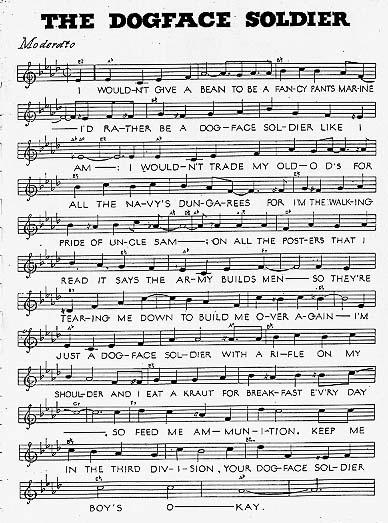
Click Here to hear WWII version from the movie “To Hell and Back” |
|
This is the original version of the 3rd Infantry Division song,’ The Dogface Soldier’. It is featured in the movie, “To Hell and Back”, the story of Audie Murphy, the most decorated soldier of World War II. This translation from World War II is not politically correct, however if this rendition is uncomfortable for you, go to the Ft. Stewart website version with current lyrics: http://www.stewart.army.mil/faq/dogface.mp3 OR http://www.stewart.army.mil/faq/dogface.wav to hear the current version of this song.Below is the link to the Fort Stewart Dogface Soldier website page http://www.stewart.army.mil/faq/DogFaceSoldierSong.asp Click here to listen to the instrumental version we use on the Society of the 3rd Infantry Division Website |
|
Official Narrative For Medal of Honor Recipient MURPHY, AUDIE L. Rank and organization: Second Lieutenant, U.S. Army, Company B, 15th Infantry, 3d Infantry Division. Place and date: Near Holtzwihr France, 26 January 1945. Entered service at: Dallas, Tex. Birth: Hunt County, near Kingston, Tex. G.O. No.65, 9 August 1945. CITATION: 2d Lt. Murphy commanded Company B, which was attacked by 6 tanks and waves of infantry. 2d Lt. Murphy ordered his men to withdraw to prepared positions in a woods, while he remained forward at his command post and continued to give fire directions to the artillery by telephone. Behind him, to his right, 1 of our tank destroyers received a direct hit and began to burn. Its crew withdrew to the woods. 2d Lt. Murphy continued to direct artillery fire which killed large numbers of the advancing enemy infantry.With the enemy tanks abreast of his position, 2d Lt. Murphy climbed on the burning tank destroyer, which was in danger of blowing up at any moment, and employed its .50 caliber machine gun against the enemy. He was alone and exposed to German fire from 3 sides, but his deadly fire killed dozens of Germans and caused their infantry attack to waver. The enemy tanks, losing infantry support, began to fall back. For an hour the Germans tried every available weapon to eliminate 2d Lt. Murphy, but he continued to hold his position and wiped out a squad which was trying to creep up unnoticed on his right flank. Germans reached as close as 10 yards, only to be mowed down by his fire. He received a leg wound, but ignored it and continued the single-handed fight until his ammunition was exhausted. He then made his way to his company, refused medical attention, and organized the company in a counterattack which forced the Germans to withdraw. His directing of artillery fire wiped out many of the enemy; he killed or wounded about 50. 2d Lt. Murphy’s indomitable courage and his refusal to give an inch of ground saved his company from possible encirclement and destruction, and enabled it to hold the woods which had been the enemy’s objective. |
|
 |
 |
 Photos courtesy of
Eric Vandroux
Photos courtesy of
Eric Vandroux
 Audie Murphy (2nd from left, 2nd row) posing with fellow GI’s
Photo taken by Capt. Hugh A. O’Neill, surgeon,
3rd Medical Battalion, 3rd Infantry Division
Audie Murphy (2nd from left, 2nd row) posing with fellow GI’s
Photo taken by Capt. Hugh A. O’Neill, surgeon,
3rd Medical Battalion, 3rd Infantry Division
|
Biographical Sketch of AUDIE LEON MURPHY Courtesy of Richard L. Rodgers Webmaster of the Audie L. Murphy Memorial Website |
|
He was America’s greatest World War II hero, at one point single-handedly holding off 250 German soldiers and six tanks. But despite winning acclaim and stardom, he could never escape the pain and trauma of the conflict that made him a hero. Through clips from his films, newsreel footage and the memories of those who knew him including his sister the heroic but tragic tale of Audie Murphy comes to life.Audie Leon Murphy, son of poor Texas sharecroppers, rose to national fame as the most decorated U.S. combat soldier of World War II. Among his 33 awards and decorations was the Medal of Honor, the highest military award for bravery that can be given to any individual in the United States of America, for “conspicuous gallantry and intrepidity at the risk of his life above and beyond the call of duty.” He also received every decoration for valor that his country had to offer, some of them more than once, including 5 decorations by France and Belgium. Credited with either killing over 240 of the enemy while wounding and capturing many others, he became a legend within the 3rd Infantry Division. Beginning his service as an Army Private, Audie quickly rose to the enlisted rank of Staff Sergeant, was given a “battle field” commission as 2nd Lieutenant, was wounded three times, fought in 9 major campaigns across the European Theater, and survived the war. During Murphy’s 3 years active service as a combat soldier in World War II, Audie became one of the best fighting combat soldiers of this or any other century. What Audie accomplished during this period is most significant and probably will never be repeated by another soldier, given today’s high-tech warfare. The U.S. Army has always declared that there will never be another Audie Murphy. |
|
On 21 September, 1945, Audie was released from the Army as an active member and reassigned to inactive status. During this same time, actor James Cagney invited Murphy to Hollywood in September 1945, when he saw Murphy’s photo on the cover of Life Magazine. The next couple of years in California were hard times for Audie Murphy. Struggling and becoming disillusioned from lack of work while sleeping in a local gymnasium, he finally received token acting parts in his first two films. His first starring role came in a 1949 released film by Allied Artists called, Bad Boy. In 1950 Murphy eventually got a contract with Universal-International (later called Universal) where he starred in 26 films, 23 of them westerns over the next 15 years.
|
|
Despite his success in Hollywood, Audie never forgot his rural Texas roots. He returned frequently to the Dallas area where he owned a small ranch for a while. He also had ranches in Perris, California and near Tucson, Arizona. He was a successful Thoroughbred and Quarter Horse racehorse owner and breeder, having interests in such great horses as “Depth Charge.” His films earned him close to 3 million dollars in 23 years as an actor. Audie loved to gamble, and he bet on horses and different sporting events. He was also a great poker player. In his role as a prodigious gambler, he won and lost fortunes.
|
|
Audie Murphy wrote some poetry and was quite successful as a songwriter. He usually teamed up with talented artists and composers such as Guy Mitchell, Jimmy Bryant, Scott Turner, Coy Ziegler, or Terri Eddleman. Dozens of Audie Murphy’s songs were recorded and released by such great performers as Dean Martin, Eddy Arnold, Charley Pride, Jimmy Bryant, Porter Waggoner, Jerry Wallace, Roy Clark, Harry Nilsson and many, many others. His two biggest hits were Shutters and Boards and When the Wind Blows in Chicago. Eddy Arnold recorded When the Wind Blows in Chicago for his 1993 album Last of the Love Song Singers which is currently in release by RCA. Audie suffered from what is now known as Post Traumatic Stress Syndrome (PTS) and was plagued by insomnia and depression. During the mid-60’s he became dependent for a time on doctor prescribed sleeping pills called Placidyl. When he recognized that he had become addicted to this prescription drug, he locked himself in a motel room, stopped taking the sleeping pills and went through withdrawal symptoms for a week. Always an advocate for the needs of veterans, he broke the taboo about discussing war related mental problems after this experience. In a effort to draw attention to the problems of returning Korean and Vietnam War veterans, Audie Murphy spoke-out candidly about his personal problems with PTS, then known as “Battle Fatigue”. He publicly called for United States government to give more consideration and study to the emotional impact war has on veterans and to extend health care benefits to address PTS and other mental health problems of returning war vets. While on a business trip on May 28, 1971, (Memorial Day Weekend) he was killed at the age of 46. A private plane flying in fog and rain crashed in the side of a mountain near Roanoke, Virginia. Five others including the pilot were also killed. Although Audie owned and flew his own plane earlier in his career at Hollywood, he was among the passengers that tragic day.
On June 7th, Audie Murphy was buried with full military honors in Arlington National Cemetery. His gravesite, near the Amphitheater, is second most visited gravesite year round. President Kennedy’s grave is the most visited.
In 1996 the Texas Legislature officially designated his birthday,
June 20th, as Audie Murphy Day.
|



|
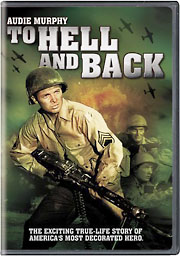
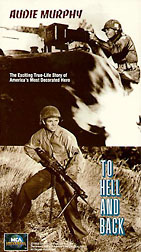
To Hell and Back (DVD/VHS) Audie Murphy, the most decorated soldier in WWII, plays himself in this 1955 film version of his military career, which culminates in his receiving the Medal of Honor. With David Janssen. (1955) (Historian: Kenneth Jackson, Professor of History, Columbia University.) [TV PG]
|
|
To Hell and Back (Paperback) His 1949 autobiography To Hell And Back was a best seller. Murphy starred as himself in a film biography released by Universal-International in 1955 with the same title. The movie, To Hell and Back, held the record as Universal’s highest grossing picture until 1975 when it was finally surpassed by the movie Jaws. In the mid-60s the studios switched from contract players to hiring actors on a picture-by-picture basis. Consequently, when his contract expired in 1965 Universal did not renew. This gave him the opportunity to work with other studios and independent film producers. In the 25 years that Audie spent in Hollywood, he made a total of 44 feature films. 
To Hell and Back by Audie Murphy |
|
AMERICAN HERO – THE LIFE AND DEATH OF AUDIE MURPHY is now available in the USA. Below are links to the book on Amazon and Barnes and Noble.
|

|
Many of the Photos on this webpage were graciously donated by Stan Smith. Other photos were from the collections of 3rd Signal Company Photographers of the 3rd Infantry Division, U.S. Army. Many of the quotes that appear here are from the book “Audie Murphy: American Soldier” written by Colonel Harold B. Simpson |